
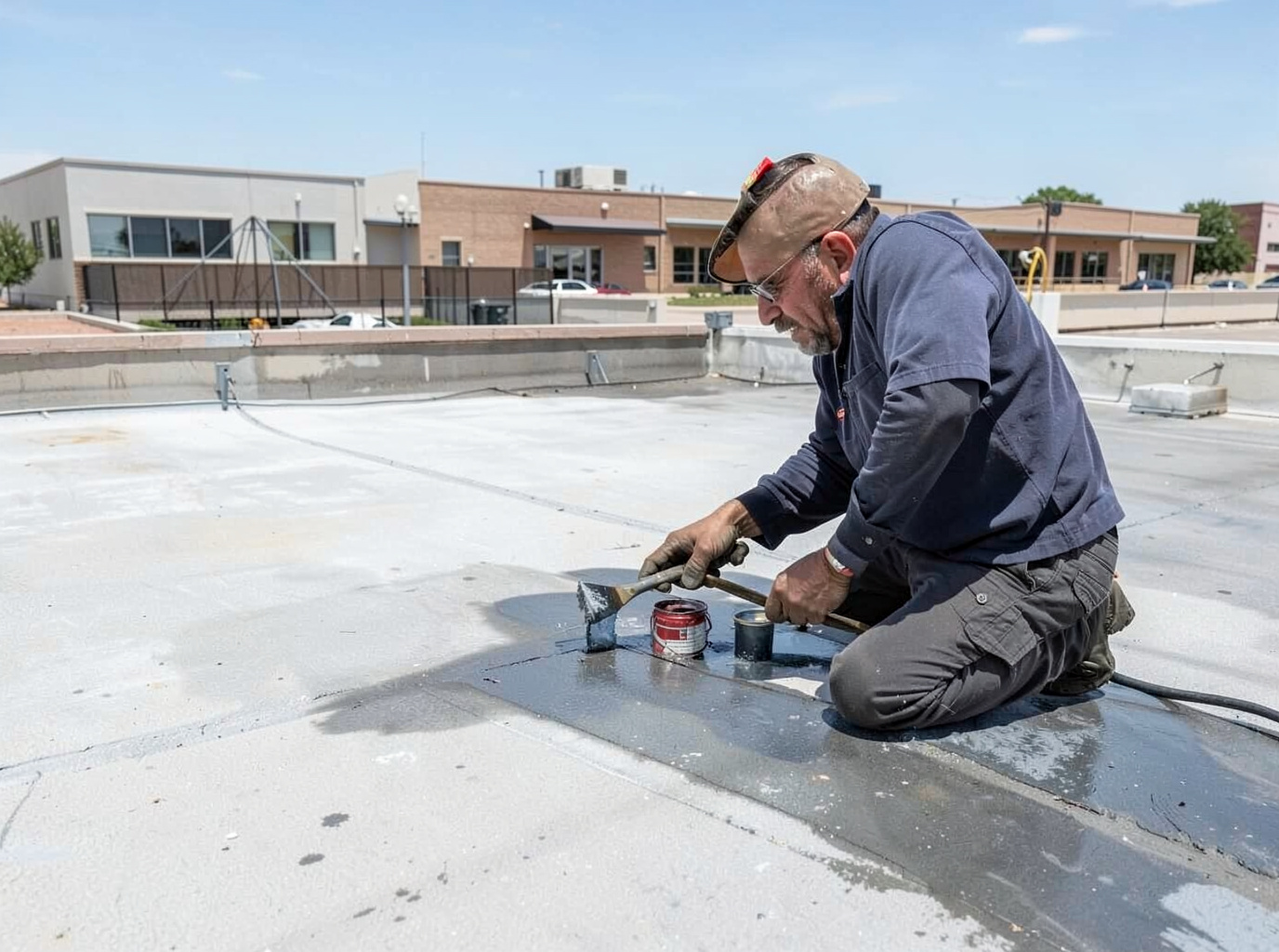
Lawton commercial buildings often feature older flat roofs installed during the 1970s and 1980s expansion around Fort Sill and the Gore Boulevard District. These systems face constant stress from humid subtropical summers that push surface temperatures above 140 degrees, causing membrane shrinkage and seam failure. Heavy spring rains then find every compromised lap, especially on low-slope sections near the Wichita Mountains where wind-driven water pools against parapets.
Technicians working in Crosstimbers and Downtown Lawton routinely encounter modified bitumen that has alligator-cracked after years of UV exposure and poor drainage. Infrared moisture scans reveal wet insulation hidden under seemingly intact surfaces, a common issue when original installs lacked proper cricket slopes. Matching the existing membrane type prevents differential movement that leads to new leaks within a single season.
Code requirements in Comanche County call for UL-rated materials on any commercial repair exceeding 25 percent of the roof area. Crews also check for updated wind uplift ratings after recent storm events that have affected buildings near Cache. Proper termination bar placement and counter-flashing details at HVAC curbs make the difference between a temporary patch and a lasting fix.
Technician insight
In Lawton, the thing that catches most people out with Commercial Flat Roof Repair is how quickly our summer heat opens seams on roofs that look fine from the ground, especially on buildings in the Gore Boulevard District where original installs never added enough slope for the heavy rains that follow.
Crosstimbers Office Roof Leak
Water was entering near an HVAC curb on a 1980s flat roof in Crosstimbers. Inspection found wet insulation under intact EPDM from a failed seam. Crews replaced the wet section, installed a new welded patch, and added counter-flashing. The building stayed dry through the next storm season.
Commercial Flat Roof Repair Services We Offer
✓TPO Membrane Patching
Heat-welded patches restore watertight integrity on TPO systems common on Lawton retail and office buildings after seam splits from thermal expansion.
✓EPDM Seam Sealing
Re-sealing and reinforcing EPDM field seams prevents water intrusion on older flat roofs in the Gore Boulevard District where age and UV have degraded factory tape.
✓Modified Bitumen Restoration
Torch-applied or cold-process coatings extend service life on modified bitumen roofs serving Comanche County commercial properties with alligatoring surfaces.
✓Drainage Improvement Repairs
Installation of additional drains and tapered crickets corrects ponding on flat roofs near Downtown Lawton where original designs lacked adequate slope.
✓Flashing and Curb Detail Repairs
Replacement of deteriorated perimeter and penetration flashings stops leaks at HVAC units and parapets on buildings throughout Crosstimbers.
Commercial Flat Roof Repair Cost in Lawton, OK
| Service | Typical Range | What Affects It |
|---|---|---|
| Small TPO seam repair | $450–$900 | Price rises with roof height and number of seams |
| EPDM wet insulation replacement | $1,200–$3,500 | Varies by area size and disposal needs |
| Modified bitumen patch section | $800–$2,200 | Larger sections near HVAC curbs cost more |
| Drainage cricket addition | $950–$2,800 | Depends on slope correction required |
Ranges are typical for Lawton, OK and confirmed with an exact written quote before any work starts.
How it works
- 1
Site Assessment
Technicians inspect the entire roof surface, test seams, and use moisture meters to map wet insulation on Lawton commercial properties.
- 2
Material Matching
Existing membrane type is identified so repairs use compatible TPO, EPDM or modified bitumen to avoid expansion mismatch.
- 3
Targeted Repair Execution
Failed sections are cut out, new membrane is installed with proper welding or adhesive, and edges are sealed to existing roof.
- 4
Final Water Test
Repaired areas receive a controlled water test to confirm no leaks before crews leave the site.
Pricing
Most commercial flat roof repairs in Lawton fall between a few hundred dollars for small patches and several thousand for larger wet-area replacements. Exact cost depends on membrane type, square footage, and accessibility.